An Introduction to Vision Language Model

AI applications nowadays generate not only text but also images, audio and videos.
The similar approach of transformer architecture is used in Vision language model also. We will see the comparison first.
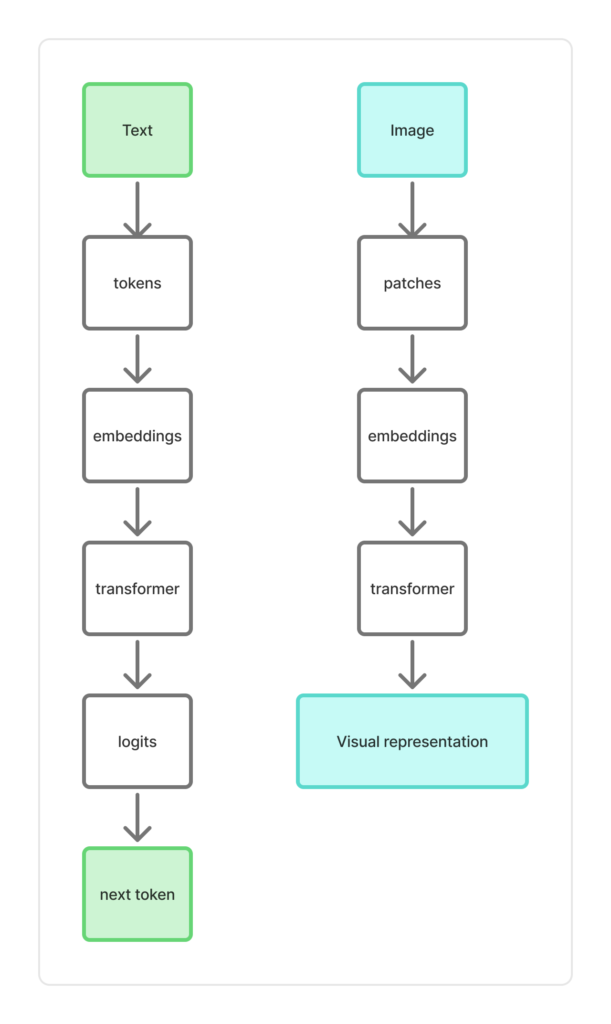
Here image patch is just a small square chunk of an image. Now a small chunk here is having image pixels.
As you know pixels are basically having RGB ( Red , Green and Blue) values.
Let’s try to understand the journey from patch to embedding in very simple and understandable way.
As we said patch is just a square piece of an image. Consider we have 4 * 4 patch portions of an image.
For a 4 * 4 patch, it will have 4*4*3 = 48 numbers.
Now a patch is flatten . i.e. take a 3D block and write all numbers in a single list (row)
As an example, let’s take a small patch as
2 × 2 patch (RGB) . Each pixel 3 values , Red , Green and Blue – (RGB).
So here there will be 4 pixels in a patch and 4 * 3 = 12 numbers
Now a single patch will look like
[ pixel1 , pixel2, pixel3 pixel4 ]
[ ( R1 , G1 , B1 ) , ( R2 , G2 , B2 ), ( R3 , G3 , B3 ), ( R4 , G4 , B4 ) ]
so after flattening , the above 3D vector becomes
[ R1, G1, B1, R2, G2, B2, R3, G3, B3, R4, G4, B4 ].
This vector just contains just raw pixel intensities. The values don’t have any meaning yet.
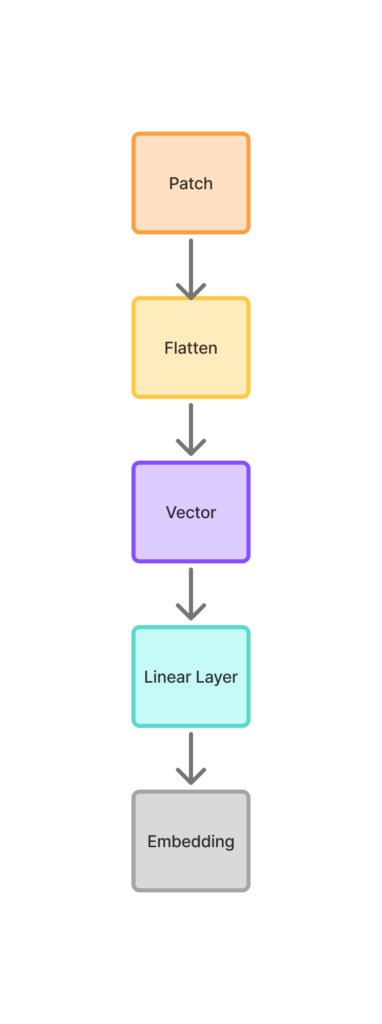
Now we will apply neural transformation on the vector (Linear Layer). Once you do it , you will learn about edges textures colors patterns , which is basically feature extraction.
Here is where “learning” actually begins.
On the above linear layer, once the neural transformation is applied , it becomes an embedding, which is patch embedding.
Now this behaves like a token.
In text based LLM, we get the token ID from vocabulary.
Related post – How LLM is predicting the next token and what is softmax?