What LLM Engineers Actually Build?
When people hear about models like LLaMA, GPT-4, or Mistral, they imagine powerful AI systems ready to solve real-world problems.
But here’s the reality:
Base models are just the starting point — not the final product.
They are:
- General-purpose (not domain-aware)
- Prone to hallucination under strict requirements
- Expensive at scale
- Risky for sensitive enterprise data
This is where LLM engineers step in.
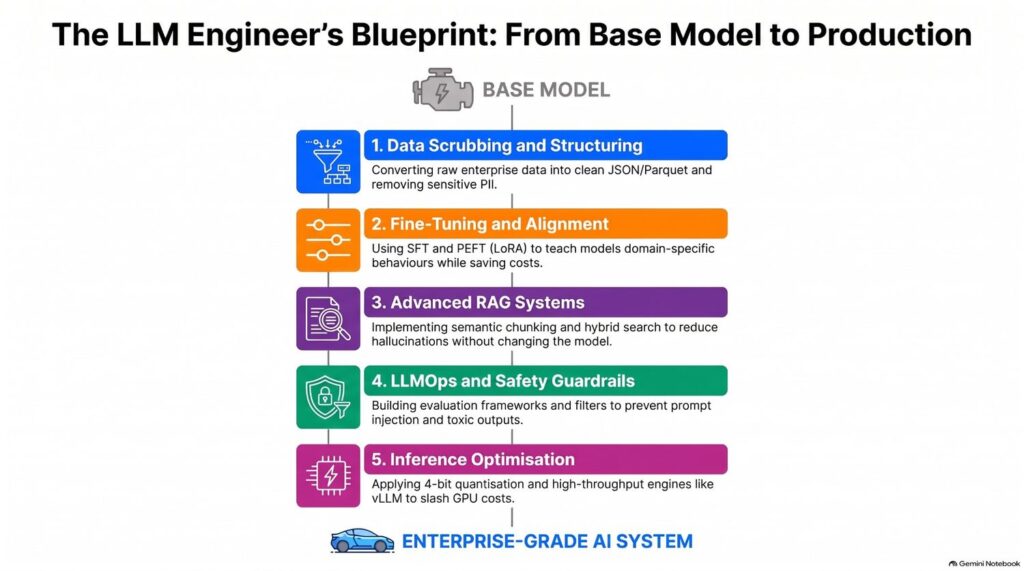
LLM engineers transform raw models into enterprise-grade AI systems by building:
Custom data pipelines
Fine-tuned domain-specific models
Retrieval systems (RAG)
Evaluation + safety layers
Optimized inference infrastructure
Think of it like this:
Base Model = Engine
LLM Engineering = Full Car (safe, efficient, road-ready)
The Production Workflow (High-Level)
A typical production pipeline looks like:
- Raw enterprise data → cleaned & structured
- Converted into embeddings → stored in vector DB
- Used to generate training datasets
- Fine-tuned using efficient frameworks
- Evaluated rigorously
- Deployed via optimized inference systems
Core Workstreams (What Actually Happens)
- Data Scrubbing:
PDFs, scanned docs, tables → converted into clean JSON/Parquet - PII Removal:
Ensuring compliance (HIPAA, PCI-DSS) - Synthetic Data Generation:
Using stronger models to generate training data
(e.g., Self-Instruct, Evol-Instruct)
👉 Insight:
Better data = better model. Always.
Fine-Tuning & Alignment (SFT + PEFT)
Techniques:
- SFT (Supervised Fine-Tuning):
Teaching models domain-specific behavior - PEFT / LoRA / QLoRA:
Train only small parts → huge cost savings - DPO / RLHF:
Align outputs with human expectations
👉 Real impact:
Run powerful models on consumer GPUs instead of expensive clusters.
3️⃣ Advanced RAG Systems (The Real Game-Changer)
Core components:
- Semantic Chunking: smarter document splitting
- Hybrid Search: vector + keyword (BM25)
- Re-ranking: filtering best context before sending to LLM
👉 Why it matters:
RAG reduces hallucination without changing the model.
4️⃣ LLMOps, Guardrails & Evaluation
Without evaluation, AI = unreliable software.
Key systems:
- Evaluation Frameworks:
Measure:- Faithfulness
- Relevance
- Context accuracy
- Guardrails:
Prevent:- Prompt injection
- Data leakage
- Toxic outputs
👉 Think of this as:
Unit tests + security layer for AI.
5️⃣ Optimization & Production Inference
Key techniques:
- Quantization:
16-bit → 4-bit models (massive savings) - Inference Engines:
- vLLM
- TensorRT-LLM
- Text Generation Inference
👉 Result:
- 3x–10x better throughput
- Lower latency
- Reduced GPU costs
The real innovation in AI today is not just in building bigger models.
It’s in:
Engineering systems around them to make them usable, reliable, and scalable.
LLM engineering is where:
- Data engineering
- Distributed systems
- Machine learning
- Backend infrastructure
all converge into one discipline.