Every distributed system eventually faces a simple question.
Who should speak first?
Should a client repeatedly ask,
“Has anything changed?”
Or should the server simply respond,
“Something changed.”
That seemingly small architectural decision determines whether your application generates thousands of unnecessary requests—or scales effortlessly to millions of users.
It is the difference between Polling and Webhooks.
Most articles explain these technologies by comparing HTTP requests. That’s useful, but it misses the bigger picture.
Polling and Webhooks aren’t API features.
They’re two fundamentally different communication philosophies.
Understanding this difference changes how you design software, not just how you call an API.
Imagine an Office That Never Stops Talking
Picture a company with 10,000 employees.
Every minute, every employee walks to Human Resources and asks,
“Has my salary changed?”
HR replies,
“No.”
One minute later…
“Has my salary changed?”
“No.”
Again.
“No.”
This continues every minute, every day, for every employee.
Ridiculous?
Of course.
Now replace:
- Employee → Client
- HR → Server
You’ve just described Polling.
Now imagine something different.
HR simply sends an email only when a salary changes.
Nobody asks.
Nobody waits in line.
Nobody wastes time.
That’s a Webhook.
Once you see Polling and Webhooks this way, you’ll never think of them as merely API techniques again.
They are two different ways systems communicate.
The Cost of Silence
Most engineers learn that polling “creates more API requests.”
Technically true.
Architecturally incomplete.
The real cost of polling isn’t requests.
It’s asking questions when the answer hasn’t changed.
Imagine an application with:
- 100,000 connected users
- Polling every 10 seconds
That results in:
- 6 requests per minute
- 360 requests per hour
- 8,640 requests per day per client
Across all users, that’s over 864 million requests every day.
Now imagine that only 2,000 actual events occurred during that same day.
Nearly every request asked the same question.
“Anything new?”
The answer was almost always…
“No.”
Most distributed systems don’t become expensive because they’re busy.
They become expensive because they’re constantly checking whether they should become busy.
The Fundamental Difference
Most explanations compare HTTP methods.
A better comparison is communication style.
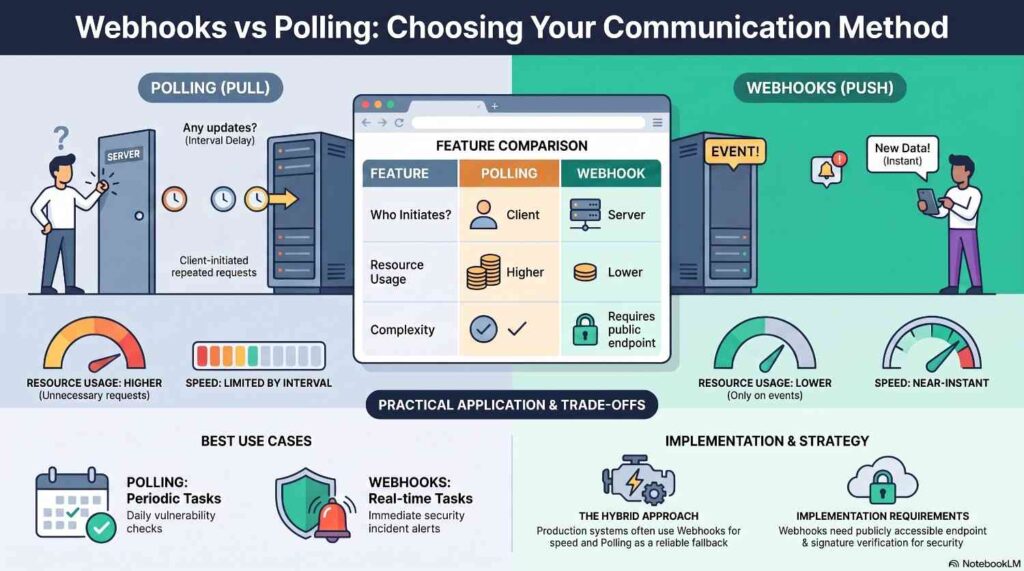
| Polling | Webhooks |
|---|---|
| Client asks for updates | Server announces updates |
| Pull-based communication | Push-based communication |
| Time-driven | Event-driven |
| Repeated conversations | Meaningful conversations |
| Optimized for simplicity | Optimized for efficiency |
Think of it this way:
Polling is curiosity.
Webhooks are awareness.
Modern Systems Don’t Like Asking Questions
Look at how large-scale systems operate.
GitHub doesn’t ask Jenkins every second if a deployment should start.
Stripe doesn’t ask merchants whether a payment completed.
Slack doesn’t poll millions of browsers every second waiting for someone to send a message.
Instead, events trigger actions.
Something happened.
Now react.
Modern software increasingly follows this principle because waiting for change is cheaper than repeatedly searching for it.
Polling Isn’t Wrong
Here’s where many articles oversimplify the discussion.
They imply that Webhooks replaced Polling.
They didn’t.
Some of the world’s largest systems still rely on polling.
Why?
Because polling solves problems that webhooks cannot.
Consider Kubernetes.
Every worker node periodically sends a heartbeat to the control plane.
That’s polling.
Why?
Because detecting silence is itself valuable.
If a heartbeat stops arriving, Kubernetes knows something failed.
No webhook can announce a crashed server after it has already crashed.
Sometimes the absence of communication is the communication.
Polling remains the simplest and most reliable solution for many monitoring scenarios.
Every Distributed System Evolves the Same Way
As applications grow, communication patterns typically evolve through predictable stages.
Stage 1 — Polling
“Anything new?”
↓
Stage 2 — Long Polling
“Wait until something changes.”
↓
Stage 3 — Server-Sent Events
“Keep the connection open.”
↓
Stage 4 — WebSockets
“We’re having a continuous conversation.”
↓
Stage 5 — Event Streaming
“Everyone interested should know.”
This progression isn’t accidental.
It reflects an industry’s continuous effort to reduce unnecessary conversations while delivering information faster.
The Architecture Behind Webhooks
Many developers think a webhook is simply an HTTP POST request.
It’s more than that.
A webhook is a promise.
It says:
“If something important happens, I’ll let you know.”
That promise introduces new engineering challenges.
- What if your server is unavailable?
- What if the notification arrives twice?
- What if events arrive out of order?
- What if delivery fails completely?
Suddenly, reliability becomes more important than communication.
That’s why production-grade webhook systems include:
- Retry policies
- Idempotency keys
- Signature verification
- Event ordering
- Dead-letter queues
Ironically, the hardest part of a webhook isn’t sending it.
It’s guaranteeing that the receiving system processes it correctly.
The Communication Decision Matrix
Choosing between Polling and Webhooks isn’t about following trends.
It’s about selecting the right communication model for the problem you’re solving.
| Situation | Best Choice |
|---|---|
| API doesn’t support callbacks | Polling |
| Real-time payment notifications | Webhooks |
| Periodic health monitoring | Polling |
| CI/CD pipelines | Webhooks |
| External partner integrations | Webhooks |
| Scheduled synchronization | Polling |
| Mission-critical workflows | Webhooks with polling fallback |
The best architectures rarely choose one exclusively.
They combine both.
Polling verifies state.
Webhooks announce change.
Together, they provide resilience.
The Bigger Lesson
Polling and Webhooks represent something much larger than API integration.
They represent two philosophies of software architecture.
One continuously searches for change.
The other reacts to change.
As systems scale, this distinction becomes increasingly important.
Modern architectures are moving toward event-driven design because events naturally reflect how the real world works.
Orders are placed.
Payments succeed.
Servers fail.
Users log in.
Security alerts trigger.
Software doesn’t need to keep asking whether these things happened.
It simply needs to know when they do.
Final Thoughts
The next time you design an integration, don’t begin by asking:
“Should I use Polling or Webhooks?”
Instead, ask a better question:
Who should speak first?
If your system constantly asks the world whether something changed, you’re designing around uncertainty.
If the world tells your system when something changes, you’re designing around events.
That shift in thinking is more than an implementation detail.
It’s one of the defining ideas behind modern distributed systems.
Because the most scalable software doesn’t succeed by asking better questions.
It succeeds by knowing exactly when to stop asking.