Break Even Calculator
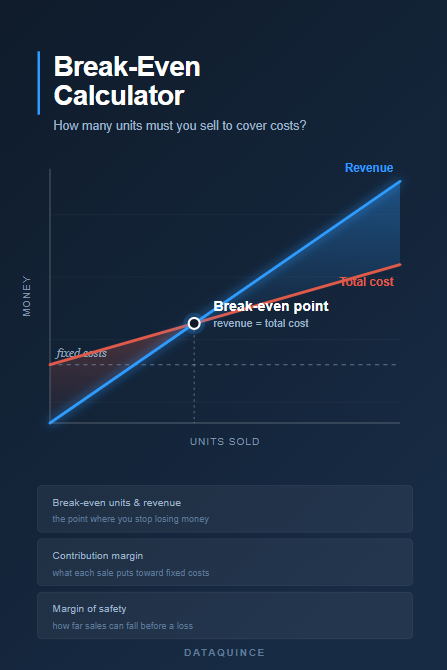
- Break-even revenue
- —
- Contribution margin per unit
- —
- Contribution margin ratio
- —
- Units for target profit
- —
- Margin of safety
- —
- Revenue
- Total cost
- Fixed costs
How this is calculated
Every unit you sell contributes its price minus its variable cost toward covering fixed costs. That amount is the contribution margin.
Break-even units = Fixed costs ⁄ (Price − Variable cost)
Break-even revenue = Fixed costs ⁄ Contribution margin ratio
With a target profit, the fixed costs figure simply becomes fixed costs plus that target. Margin of safety is how far your expected sales sit above break-even, as a percentage — it tells you how much sales can fall before you start losing money.
Where this model bends in practice
The straight lines assume price and variable cost stay constant at every volume. They rarely do. Bulk discounts pull your average price down as you scale, supplier discounts pull variable cost down, and fixed costs step up rather than stay flat — hire one more person and the whole line jumps.
Treat the result as the answer for your current cost structure, not a forecast across all volumes. If your break-even sits far above anything you have sold before, the honest reading is usually that the price is too low or the fixed base is too heavy, not that you simply need to sell more.