Metal model for SQL queries
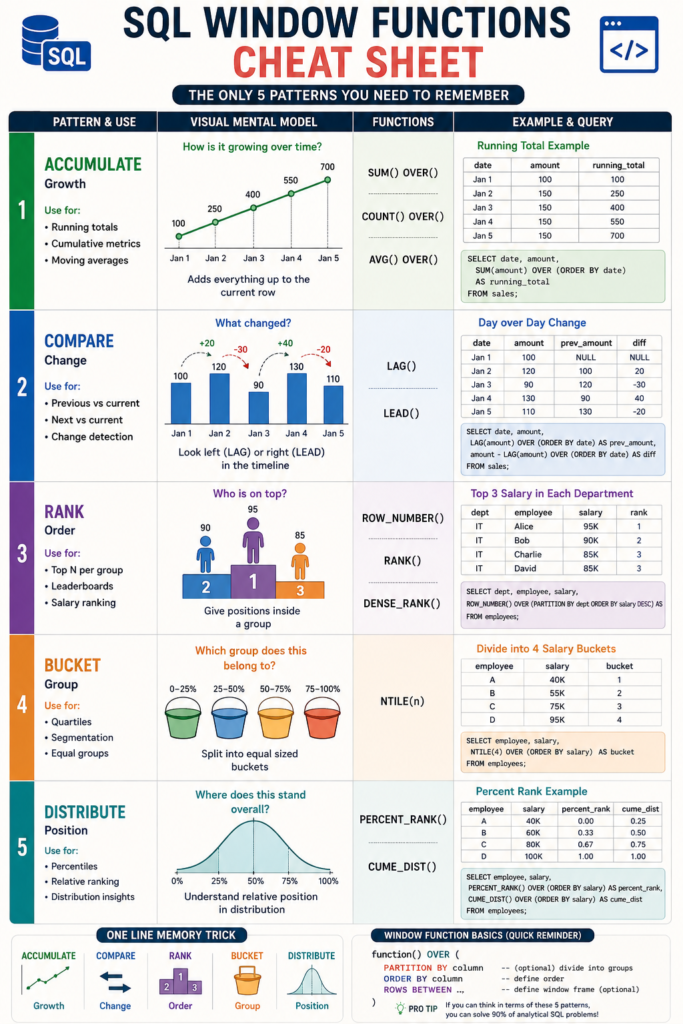
These are some ways of thinking about applying the fucntion to make the SQL query for a problem.
1. Looking Across Rows
LAG()→ look backLEAD()→ look forward
2. Accumulating
SUM() OVER()→ running totalAVG() OVER()→ running average
3. Ranking
ROW_NUMBER()→ unique orderRANK()→ gapsDENSE_RANK()→ no gaps
4. Bucketing
NTILE(4)→ quartiles
5. Distribution
PERCENT_RANK()CUME_DIST()
Lets think we are given a sales transactions dataset.
sales (
  order_id INT,
  customer_id INT,
  order_date DATE,
  amount DECIMAL
)
Can you show me running totals?
SELECT
  order_date,
  amount,
  SUM(amount) OVER (ORDER BY order_date) AS running_total
FROM sales;

“Compare each order with the previous one.”
“Compare each order with the previous one.”
SELECT
  order_id,
  amount,
  LAG(amount) OVER (ORDER BY order_date) AS prev_amount,
  amount - LAG(amount) OVER (ORDER BY order_date) AS diff
FROM sales;
“I want top 3 customers per region.”
SELECT *
FROM (
  SELECT
    customer_id,
    region,
    SUM(amount) AS total_spent,
    ROW_NUMBER() OVER (PARTITION BY region ORDER BY SUM(amount) DESC) AS rn
  FROM sales
  GROUP BY customer_id, region
) t
WHERE rn <= 3;
“Your dataset has missing days”
SELECT
  order_date,
  LAG(order_date) OVER (ORDER BY order_date) AS prev_date,
  order_date - LAG(order_date) OVER (ORDER BY order_date) AS gap
FROM sales;
“Smooth the noise. Show me a 3-day moving average.”
SELECT
  order_date,
  amount,
  AVG(amount) OVER (
    ORDER BY order_date
    ROWS BETWEEN 2 PRECEDING AND CURRENT ROW
  ) AS moving_avg
FROM sales;
“Remove duplicates, keep latest”
SELECT *
FROM (
  SELECT *,
         ROW_NUMBER() OVER (
           PARTITION BY order_id
           ORDER BY order_date DESC
         ) AS rn
  FROM sales
) t
WHERE rn = 1;
“Who improved month over month?”
SELECT
  customer_id,
  order_date,
  amount,
  LAG(amount) OVER (
    PARTITION BY customer_id
    ORDER BY order_date
  ) AS prev_amount,
  amount - LAG(amount) OVER (
    PARTITION BY customer_id
    ORDER BY order_date
  ) AS growth
FROM sales;